In the 1930s, Malcolm MacLean, New Jersey modified trucks to become “container” and loaded into container ship. As of 1 October 2010, the cellular fleet numbered 4725 (of containerships) with the total capacity of 13.8 million teu (Container Forecaster 4Q10, page 27). What an amazing invention!
The development of container port is driven by some key factors:
• Globalization – international trade
• Containerization
• Technology advancement
• 90% trade by sea
• Cost efficiency
• Customer demand – more and faster
• ISO of containers started in 1960s.
I would suggest two critical success factors: facilities and technology. Facilities are to do with the physical movements of containers while technologies are to deal with the intangible management of information. In my opinion, if RFID is being adopted in port management it would be revolutionized.
Ports are trying to integrate vertically or to embrace total logistics. If this trend continues to development, I think the survival of small companies in the future will be in question. Another issue faces by port is concerning with the extent of in-housing or outsourcing of its business activities. How could ports draw lines to separate core and non-core activities?
Finally, I think the potential risk for containerization port would be the invention of a replacement for container. Would there be a change from “Containerization Port” to “Replacement Port”?
Thursday, July 14, 2011

Tuesday, April 26, 2011
Customs Form No 6 – K6
K6 is a transhipment manifest with the purpose to advice for ICT bound container.

Source:
http://www.google.co.uk/url?sa=t&source=web&cd=1&ved=0CCIQFjAA&url=http%3A%2F%2Fwww.pka.gov.my%2Fphocadownload%2Fdockit14.pdf&rct=j&q=Transhipment%20Manifest%20%28K6%29%20&ei=gZu2TcrRB8qx8QOA8JFD&usg=AFQjCNGtwQIZcyxzGfe3x0F7l6hEhAso7w&cad=rja
Related in formation:
http://www.google.co.uk/url?sa=t&source=web&cd=5&ved=0CDgQFjAE&url=http%3A%2F%2Fwww.miti.gov.my%2Fcms%2Fstorage%2Fdocuments%2F8ee%2Fcom.tms.cms.document.Document_4752de37-c0a81573-10311031-4449081c%2F1%2FTransshipment%2520Flow%2520-%2520Finalised%2520250809.pdf&rct=j&q=Transhipment%20Manifest%20%28K6%29%20&ei=gZu2TcrRB8qx8QOA8JFD&usg=AFQjCNH_bG0xw0m9WlnyWDsrLzzhjXei0g&cad=rja
http://www.ictipoh.com.my/Services/CustomBrokerage.aspx

Source:
http://www.google.co.uk/url?sa=t&source=web&cd=1&ved=0CCIQFjAA&url=http%3A%2F%2Fwww.pka.gov.my%2Fphocadownload%2Fdockit14.pdf&rct=j&q=Transhipment%20Manifest%20%28K6%29%20&ei=gZu2TcrRB8qx8QOA8JFD&usg=AFQjCNGtwQIZcyxzGfe3x0F7l6hEhAso7w&cad=rja
Related in formation:
http://www.google.co.uk/url?sa=t&source=web&cd=5&ved=0CDgQFjAE&url=http%3A%2F%2Fwww.miti.gov.my%2Fcms%2Fstorage%2Fdocuments%2F8ee%2Fcom.tms.cms.document.Document_4752de37-c0a81573-10311031-4449081c%2F1%2FTransshipment%2520Flow%2520-%2520Finalised%2520250809.pdf&rct=j&q=Transhipment%20Manifest%20%28K6%29%20&ei=gZu2TcrRB8qx8QOA8JFD&usg=AFQjCNH_bG0xw0m9WlnyWDsrLzzhjXei0g&cad=rja
http://www.ictipoh.com.my/Services/CustomBrokerage.aspx
Monday, May 3, 2010
Types of wooden pallets & Pallet design


Way = entry for the forklift and stackers
Deck = One or more boards or panels comprising the top or bottom surface of the pallet
Wing = Overhang of deck board end from outside edge of stringer or stringer-board
Reversible = A pallet with identical top and bottom decks
Source: http://www.indiamart.com/nirmalindustries/wooden-pallet.html

Source: http://www.premier-pallets.com/definitions.asp
Glossary of pallet: http://www.premier-pallets.com/definitions.asp
Monday, March 8, 2010
Sunday, February 7, 2010
Crop to Shop: Jimmy's Supermarket Secrets (Video)
Jimmy Doherty explores the global logistics that bring fresh food from around the world to a shop near you, and uncovers the the science that keeps food fresh for weeks.
Broadcast on: BBC One, 7:30pm Wednesday 3rd February 2010
Duration: 60 minutes
Categories: * Factual, * Consumer
Video can be viewed from:
http://bbc.co.uk/i/qn0by/
or
http://www.bbc.co.uk/iplayer/episode/b00qn0by/b00qn0b3/Crop_to_Shop_Jimmys_Supermarket_Secrets/#more-downloads
Broadcast on: BBC One, 7:30pm Wednesday 3rd February 2010
Duration: 60 minutes
Categories: * Factual, * Consumer
Video can be viewed from:
http://bbc.co.uk/i/qn0by/
or
http://www.bbc.co.uk/iplayer/episode/b00qn0by/b00qn0b3/Crop_to_Shop_Jimmys_Supermarket_Secrets/#more-downloads
Friday, November 27, 2009
OASIS OF THE SEA - The world's biggest cruise ship

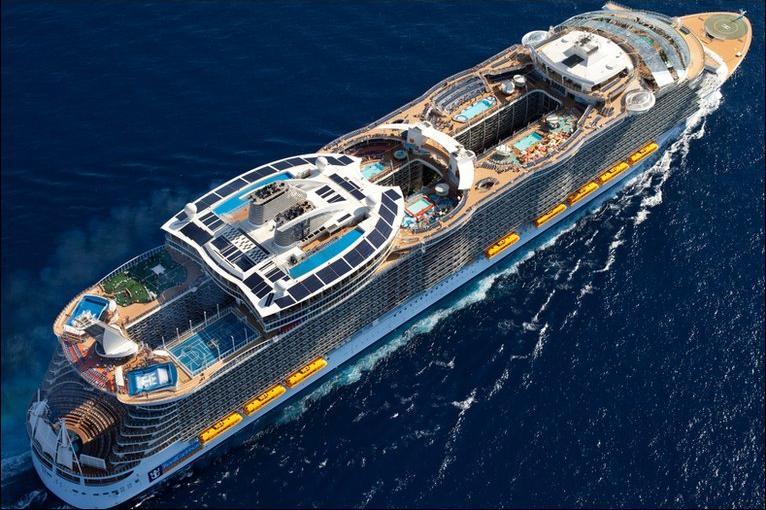
Cater for: more than 6,000 passengers
Cabling: more than 3,000 miles of electrical cabling - that is about the distance from London to New York
Weight: more than 225,000 tonnes
Cost: more than £800m
Date of completion: 28 October 2009
Speed: 22.6 knots (41.9 km/h; 26.0 mph)
Souce: http://news.bbc.co.uk/1/hi/business/8380738.stm
Thursday, July 16, 2009
Idling ships clog up Singapore shores
From the top of Singapore's Equinox bar you can see the city skyline and ship after ship after ship.
Singapore claims to be the busiest port in the world, with some 130,000 ship arrivals each year.
But these days, the problem is many of those vessels are not putting back out to sea.
The usual stay for a cargo carrier is just ten days. That is enough time to offload one set of cargo and take on another load, re-fuel and re-stock supplies.
But, of the 220 container ships arriving in Singapore this year, - excluding the tugs, yachts and bunkering vessels which are permanent port residents - more than half have stayed longer than that.
Another 44 cargo ships have been in port for more than six months.

Time is money
It costs about $1,000 (£614) per day to keep a ship at Singapore port.
On top of that, most of these ships would have been bought with multi-million dollar loans that need to be serviced.
They will have a crew that needs to be paid, fed and watered. Engines and machinery that need to be maintained.
All of this is necessary for a ship to maintain its class - the equivalent of an MOT or bill of health.
Being taken "out of class" means a ship cannot trade or earn money and cannot be insured for voyage on the open sea.
Staying afloat
The sharp downturn in world trade is behind this enforced idleness.
And, in the absence of global economic recovery, all firms can do is minimise their costs.
A ship owner can save up to 80% of his or her running costs just by laying anchor 45 minutes south of Singapore, off the Indonesia islands of Batam-Rempang-Galang.
Earlier this year, Rob Wilkins, general manager, Enviro Force, opened a new anchorage off Galang.
"In Singapore you have to maintain a full crew (25-30 people on average) on-board your vessel," he says.
"In Batam you don't.
"You can save on insurance costs, maintenance costs and crew costs by laying up here instead."
Laying anchor
Mr Wilkins and his partner Damian Chapman are serial entrepreneurs.
For months, they have noticed more and more vessels idling in ports, running up huge costs. According to AXS Alphaliner, 511 container ships are laid up.
That is a tenth of the global fleet.
"Laying up" is the term for taking a ship out of service.
There are different levels: hot stacking requires the engines to be fired up every day, allowing a vessel to be brought back into service in days; but a vessel kept in cold stack can be welded closed with engines off for months at a time.
At the most extreme end, ship owners can take the ship out of class and save hundreds of thousands of dollars in insurance costs alone.
Treading water
But, these are drastic measures.
Ship owners have a range of options before they lay-up their vessels.
The most common is idling your vessel beyond the port perimeters.
On the ferry between Batam and Singapore, Damian points out ships that have been left anchored for months.
They don't pay port dues which saves them money but also means they don't have access to port services.
One Singaporean shipmaster (who wants to remain unnamed) brags business is booming since he turned his two small service ships over to water supplies.
Crew on these idling vessels are not allowed to go ashore for food or water.
Sink or swim
A rusting oil tanker also sits outside Singapore limits.
Damian says it is being used for storage.
"When the oil price was low, it was worth buying up crude and holding onto it until the price rose," he says.
"That tanker will probably be sold for scrap… as soon as scrap metal prices recover."
And that's a big problem. Even for those owners who want to cut their losses and sell up, the market is grim.
Jonathan Le Feuvre, managing director of shipping services firm Fearnleys Asia, says "scrap metal prices are down 75% from their peak a year ago".
"And," he adds, "there are no trading buyers" who would buy the ship as a going concern.
Only those who have to sell, perhaps forced by their bank, would sell up at such low prices.
Mr Le Feuvre recites anecdotes of Chinese and Greek shipping owners who have snapped up bargains at a 90% discount from the peak.
Anchors aweigh
There is, however, some sign of hope on the horizon: China.
"It's the only game in town," according to Mr Le Feuvre.
"It is single-handedly lifting the dry sector (trade in coal, metal ores and other raw materials) out of recession," he says.
"Ten months ago, owners of Capesize bulk carriers (ships carrying 150,000-170,000 dead weight tonnage used for the transport of, say, iron ore and coal) were effectively transporting cargo for free at charter rates of $5,000 a day."
On 8 July, rates hit $67,000 a day.
Eye of the storm
But, many question whether this recovery in the dry sector can be sustained.
Owners of smaller container ships used to transport consumer goods such as cars, televisions and refrigerators say business remains slow.
There is still little sign people in the United States and Europe are returning to shops to buy these shipped goods.
And dismal US jobs data suggests economic recovery will take longer than hoped.
AXS Alphaliner predicts a quarter of the container fleet will be idle by the end of next year.
"Things will look pretty rosy in containers about 18 months from now' time," says Mr Le Feuvre, "but we're going to go through a year and a half of hell to get there."
Source: http://news.bbc.co.uk/2/hi/business/8142838.stm, 10 July 2009
Singapore claims to be the busiest port in the world, with some 130,000 ship arrivals each year.
But these days, the problem is many of those vessels are not putting back out to sea.
The usual stay for a cargo carrier is just ten days. That is enough time to offload one set of cargo and take on another load, re-fuel and re-stock supplies.
But, of the 220 container ships arriving in Singapore this year, - excluding the tugs, yachts and bunkering vessels which are permanent port residents - more than half have stayed longer than that.
Another 44 cargo ships have been in port for more than six months.

Time is money
It costs about $1,000 (£614) per day to keep a ship at Singapore port.
On top of that, most of these ships would have been bought with multi-million dollar loans that need to be serviced.
They will have a crew that needs to be paid, fed and watered. Engines and machinery that need to be maintained.
All of this is necessary for a ship to maintain its class - the equivalent of an MOT or bill of health.
Being taken "out of class" means a ship cannot trade or earn money and cannot be insured for voyage on the open sea.
Staying afloat
The sharp downturn in world trade is behind this enforced idleness.
And, in the absence of global economic recovery, all firms can do is minimise their costs.
A ship owner can save up to 80% of his or her running costs just by laying anchor 45 minutes south of Singapore, off the Indonesia islands of Batam-Rempang-Galang.
Earlier this year, Rob Wilkins, general manager, Enviro Force, opened a new anchorage off Galang.
"In Singapore you have to maintain a full crew (25-30 people on average) on-board your vessel," he says.
"In Batam you don't.
"You can save on insurance costs, maintenance costs and crew costs by laying up here instead."
Laying anchor
Mr Wilkins and his partner Damian Chapman are serial entrepreneurs.
For months, they have noticed more and more vessels idling in ports, running up huge costs. According to AXS Alphaliner, 511 container ships are laid up.
That is a tenth of the global fleet.
"Laying up" is the term for taking a ship out of service.
There are different levels: hot stacking requires the engines to be fired up every day, allowing a vessel to be brought back into service in days; but a vessel kept in cold stack can be welded closed with engines off for months at a time.
At the most extreme end, ship owners can take the ship out of class and save hundreds of thousands of dollars in insurance costs alone.
Treading water
But, these are drastic measures.
Ship owners have a range of options before they lay-up their vessels.
The most common is idling your vessel beyond the port perimeters.
On the ferry between Batam and Singapore, Damian points out ships that have been left anchored for months.
They don't pay port dues which saves them money but also means they don't have access to port services.
One Singaporean shipmaster (who wants to remain unnamed) brags business is booming since he turned his two small service ships over to water supplies.
Crew on these idling vessels are not allowed to go ashore for food or water.
Sink or swim
A rusting oil tanker also sits outside Singapore limits.
Damian says it is being used for storage.
"When the oil price was low, it was worth buying up crude and holding onto it until the price rose," he says.
"That tanker will probably be sold for scrap… as soon as scrap metal prices recover."
And that's a big problem. Even for those owners who want to cut their losses and sell up, the market is grim.
Jonathan Le Feuvre, managing director of shipping services firm Fearnleys Asia, says "scrap metal prices are down 75% from their peak a year ago".
"And," he adds, "there are no trading buyers" who would buy the ship as a going concern.
Only those who have to sell, perhaps forced by their bank, would sell up at such low prices.
Mr Le Feuvre recites anecdotes of Chinese and Greek shipping owners who have snapped up bargains at a 90% discount from the peak.
Anchors aweigh
There is, however, some sign of hope on the horizon: China.
"It's the only game in town," according to Mr Le Feuvre.
"It is single-handedly lifting the dry sector (trade in coal, metal ores and other raw materials) out of recession," he says.
"Ten months ago, owners of Capesize bulk carriers (ships carrying 150,000-170,000 dead weight tonnage used for the transport of, say, iron ore and coal) were effectively transporting cargo for free at charter rates of $5,000 a day."
On 8 July, rates hit $67,000 a day.
Eye of the storm
But, many question whether this recovery in the dry sector can be sustained.
Owners of smaller container ships used to transport consumer goods such as cars, televisions and refrigerators say business remains slow.
There is still little sign people in the United States and Europe are returning to shops to buy these shipped goods.
And dismal US jobs data suggests economic recovery will take longer than hoped.
AXS Alphaliner predicts a quarter of the container fleet will be idle by the end of next year.
"Things will look pretty rosy in containers about 18 months from now' time," says Mr Le Feuvre, "but we're going to go through a year and a half of hell to get there."
Source: http://news.bbc.co.uk/2/hi/business/8142838.stm, 10 July 2009
Monday, July 13, 2009

Wednesday, June 24, 2009
French shipping giant CMA CGM keen to strengthen presence in Malaysia
 Marseille is France's largest commercial port
MARSEILLE: Malaysia’s liberalisation of 27 local services sub-sectors, including the transport sub-sector, prompted French shipping giant, CMA CGM to mull over plans to strengthen its foothold in the country.
Transport Minister Datuk Seri Ong Tee Keat had during a visit to the headquarters of the world’s third largest container shipping company in the French city last Thursday shared the Malaysian Government’s policy to liberalise the transport sub-sector, including the opening of 30% restriction in foreign ownership.
CMA CGM has had a presence in Port Klang since 1994 and is one of the largest customers of Port Klang. It has since June 1 also served the port of Tanjung Pelepas.
In welcoming the move, the company’s president Jacques R. Saade said “such liberalisation will change the strategy (of the company) in Asia.”
The shipping giant also welcomed Ong’s announcement of gradual liberalisation of cabotage of key sectors such as from Peninsular Malaysia to three major ports in east Malaysia, namely Sepangar, Kuching and Bintulu. (See also page 7)
Saade said the company would seriously explore the opportunities available from such a move. He also said the company would expand its dry port bonded warehouses, which include the Port Klang Free Zone.
Later, Ong visited the Port of Marseille, one of the oldest and busiest sea ports in France.
Marseille Port also raised its interest to establish an in-house university specialising in shipping and maritime as part of its education and training project.
Ong took the opportunity to test-drive its state-of-the-art port simulator.
Source: http://thestar.com.my/maritime/story.asp?file=/2009/6/22/maritime/4167711&sec=maritime, 22 June 2009
Port Klang poised to be London Metal Exchange hub

Accreditation by London Metal Exchange a big boost for port
LONDON: Port Klang is poised to become Asia’s leading distribution hub for the London Metal Exchange (LME) following its accreditation as the exchange’s Good Delivery Point.
The move will further enhance Malaysia’s image as a major regional logistics centre for LME trade, according to Port Klang Free Zone general manager Chia Kon Leong.
He said Port Klang’s listing was fast-tracked as it had always been LME-ready with its excellent port infrastructure, strong logistics support and sound operational systems.
Chia said the port was strategically located to capitalise on the burgeoning LME trade from producing countries like Australia and Europe to the vast consuming markets of South East Asia and China/Far East.
“We reckoned that Port Klang is targeting to receive 150,000 to 200,000 tonnes of metals within the next six months,” he said.
Chia had earlier witnessed the presentation of the Letter of Accreditation from the exchange’s CEO Martin Abbott to Transport Minister Datuk Seri Ong Tee Keat at the LME boardroom in London on Friday.
Established for over 130 years, the LME is the world’s premier non-ferrous metals market, offering futures and options contracts for aluminium and aluminium alloy, copper, nickel, tin, zinc, lead and plastics.
With a turnover in excess of US$3 trillion per annum, the LME also contributes to the UK’s invincible earnings to the tune of more than £250mil in overseas earnings each year.
Port Klang’s listing as a Good Delivery Point was approved by the LME on May 8, thereby allowing the port to receive LME-traded metals since June 10.
The accreditation is of immense significance to Malaysia as there are now only two other approved listed delivery locations in South East Asia, namely Pasir Gudang in Johor and Singapore.
LME delivery points are mainly in major ports around the world, which must meet strict criteria before they are approved for the handling of metals and plastics traded through the exchange.
Chia said Port Klang was strategically located at the crossroads of the world’s busiest shipping lane as well as being the world’s 15th busiest container port and one of Asia’s largest multi-purpose ports.
He said the port was centrally located in South East Asia, close to the huge consumer market in China which had no delivery points despite the enormous volumes of LME metals being shipped there.
“We’re close to consuming areas but away from major producers like those in Australia,” he said, citing BHP Billiton as one of the world’s largest mining companies.
Chia also said Port Klang was unique in a sense as within its free zone, there were companies which could consume such metals.
He said one firm, for instance, could actually get its copper supply from within the free zone, unlike other delivery points which were purely distribution areas.
He added that the listing had enhanced Port Klang’s resilience in facing the recessionary environment as metals needed to be stored due to lower consumption.
“We provide LME traders, warehouse companies and other users with highly competitive rates backed by cost-effective and efficient operations,” he added.
Ong said Port Klang was offering not just one port terminal but two and 405 ha of (Port Klang) free zone as a delivery location.
“And that free zone certainly has vast potentials that will suit the LME’s business purposes,” he noted.
Abbott said the LME appreciated the fact that Malaysia operated a fiscal regime that was encouraging to the international business community.
“With regards to Asia in general, as probably the biggest single growth area for the LME in the next 10 to 20 years, we’re very happy to have Malaysia and Port Klang as our strategic partners in our long-term business growth,” he added.
Source: http://thestar.com.my/maritime/story.asp?file=/2009/6/22/maritime/4164516&sec=maritime, 22 June 2009
Monday, June 1, 2009
M’sia ready for IATA e-freight service

MALAYSIA’s airfreight industry has received recognition from the International Air Transport Association (IATA) as a site ready for the IATA e-freight service.
The Malaysia IATA e-freight implementation team, led by Malaysia Airlines Cargo Sdn Bhd (MASkargo), started work in February and delivered the IATA e-freight on schedule.
Also involved were Royal Malaysian Customs, Emirates, Singapore Airlines, Cathay Pacific, KLM, DHL Global Forwarding, DB Schenker, the Airfreight Forwarders Association of Malaysia, Penang Freight Forwarders Association, Federation of Malaysia Freight Forwarders, Kuala Lumpur Airport Services and Malaysia Airports (Sepang) Sdn Bhd – KLIA Free Zone Authority.
IATA e-freight became operational between Kuala Lumpur and Hong Kong, Singapore and Dubai on May 26, with further expansion planned in the coming months to South Korea and The Netherlands.
Facilitated by IATA, the project is an industry-wide initiative involving carriers, freight forwarders, ground handlers, shippers and customs authorities.
IATA e-freight effectively eliminates the need to send paper documents with air-cargo shipments, thereby streamlining processes, improving speed and reliability and cutting costs.
Over the past year IATA has assessed the readiness of 148 locations worldwide in addition to the original six e-freight sites.
Of these, 44 countries, representing approximately 80% of global air-freight volumes, have the appropriate international treaties and high level customs framework in place to qualify for IATA e-freight.
Malaysia is the 20th e-freight location worldwide to deliver paper-free cargo documents.
MASkargo managing director Shahari Sulaiman said the implementation of the e-freight programme would lift their status to be on par with established industry players.
“The e-freight programme that MASkargo is embarking on will bring tangible benefits by simplifying the business, reducing costs and improving opportunities in the industry’s ever-changing and complex environment,” he said.
Source:http://thestar.com.my/maritime/story.asp?file=/2009/6/1/maritime/4003402&sec=maritime, 01 June 2009
Monday, May 11, 2009
Reader’s Digest Trusted Brand award for FedEx

FEDEX Express, a subsidiary of FedEx Corp listed on New York Stock Exchange, has been named a Trusted Brand by readers of Reader’s Digest across the Asia-Pacific.
In this year’s Reader’s Digest Trusted Brands in Asia Survey, FedEx won the Gold Award for the sixth consecutive year in the overall Asia regional category of the airfreight/courier service division.
“It is an honor for FedEx to be recognised as a trusted brand and service provider by customers in this region for six years in a row.
“FedEx has always been focused on making every customer experience outstanding since we established operations in Asia 25 years ago,” said David L. Cunningham Jr, president of FedEx Asia-Pacific, in a statement.
“The results from this year’s Reader’s Digest Trusted Brands in Asia Survey reflects FedEx’s success in delivering and anticipating what customers want,” he said.
Inaugurated in 1999, the Reader’s Digest Trusted Brands in Asia Survey is the region’s most comprehensive poll that seeks to identify Asia’s most trusted companies.
In addition to trustworthiness and credibility, the survey also measures the companies’ commitment to innovation, quality of services and products, corporate values, understanding of customer needs as well as corporate social responsibility.
Source: http://thestar.com.my/maritime/story.asp?file=/2009/5/11/maritime/3869058&sec=maritime, 11 May 2009
Northport wins Asia’s best container terminal award

NORTHPORT (M) Bhd bagged The Best Container Terminal Award (Asia) at the Asian Freight and Supply Chain Awards 2009 held in Hong Kong recently.
Northport, a multi-purpose terminal, was selected for the award from a list which included other top container terminals in Asia.
The selection was based on a list of criteria, which included crane productivity, timely and adequate investment in new terminal infrastructure to meet future demand, effective use of information technology and efficient turn-around of trucks delivering and picking up containers.
Northport, which handled three million twenty-foot equivalent units (TEUs) last year, offers one of the widest shipping connectivity among ports in Malaysia with about 123 container shipping lines linking it to some 300 ports worldwide.
Managing director Datuk Basheer Hassan Abdul Kader said in a statement that Northport was committed to maintaining high performance and productivity because leading shipping lines that called at the port required standards comparable with other major global ports to which they were linked.
Last year, 81 shipping lines as well as 44 conventional and 502 container vessels made about 8,000 ship calls at Northport.
On the impact on the global economic downturn, Basheer said container cargo through Northport dropped 15% (year-on-year) in the first quarter of this year.
Northport is one of the major hubs in Malaysia for exporting cargos and this moderate decrease was within expectation.
Source: http://thestar.com.my/maritime/story.asp?file=/2009/5/11/maritime/3869211&sec=maritime, 11 May 2009
Monday, May 4, 2009
MISC logistics arm’s facilities certified halal

MISC Integrated Logistics’ (MILS) storage and warehousing facilities have been certified halal by Halal Development Corp (HDC).
MISC said in a statement that the certification was awarded based on the merits of hygiene and syariah compliance for both dry and cold storage.
The integrated logistics arm of MISC Bhd is located at the MISC Logistics Hub (MLH) Free Commercial Zone (FCZ) on Pulau Indah, Port Klang.
MILS’ dry warehouse, with 250,000 sq ft of space, can handle 23,000 pallets.
The cold-storage facility is able to accommodate multiple temperatures ranging from 18°C to -25°C. The cold room is equipped with mobile racking solution with a capacity for 8,500 pallet positions for frozen products and 1,200 pallet positions for chilled products.
The storage facility at the FCZ, coupled with MISC’s Halal Express Service shipping route, makes MISC one of few companies truly capable of offering customers the entire value chain in halal logistics.
MILS has also formed a joint venture in Dubai, which will give it the opportunity to tap and strengthen the group’s connectivity and promote the halal capabilities of MILS logistics hub in Malaysia.
The hub can be seen as a bridge to Africa, the Middle East and Europe where the halal markets are huge.
Source: http://thestar.com.my/maritime/story.asp?file=/2009/5/4/maritime/3815066&sec=maritime, 04 May 2009
MISC said in a statement that the certification was awarded based on the merits of hygiene and syariah compliance for both dry and cold storage.
The integrated logistics arm of MISC Bhd is located at the MISC Logistics Hub (MLH) Free Commercial Zone (FCZ) on Pulau Indah, Port Klang.
MILS’ dry warehouse, with 250,000 sq ft of space, can handle 23,000 pallets.
The cold-storage facility is able to accommodate multiple temperatures ranging from 18°C to -25°C. The cold room is equipped with mobile racking solution with a capacity for 8,500 pallet positions for frozen products and 1,200 pallet positions for chilled products.
The storage facility at the FCZ, coupled with MISC’s Halal Express Service shipping route, makes MISC one of few companies truly capable of offering customers the entire value chain in halal logistics.
MILS has also formed a joint venture in Dubai, which will give it the opportunity to tap and strengthen the group’s connectivity and promote the halal capabilities of MILS logistics hub in Malaysia.
The hub can be seen as a bridge to Africa, the Middle East and Europe where the halal markets are huge.
Source: http://thestar.com.my/maritime/story.asp?file=/2009/5/4/maritime/3815066&sec=maritime, 04 May 2009
Monday, April 27, 2009
MMC hurt by low cargo volume

MMC Corp Bhd sees lower revenue contribution from its port business in Johor this year due to the drop in cargo volume, said chief executive officer Hasni Harun.
Both its ports in the state, Port of Tanjung Pelepas (PTP) and Johor Port, had been hit by the global recession, he said.
“Ports in the region have been experiencing a decline in volume of between 15% and 20% since the fourth quarter last year.
“There has been a spike in volume last month due to the replenishment of depleted inventories but it is premature to say whether this is sustainable.
“Subject to an improvement in consumer confidence globally, the situation may not lead to a long and deep downturn. It might improve in 2010 and we hope to maintain what we’ve achieved last year,” he told StarBiz.
PTP registered a container throughput of 5.6 million twenty-foot equivalent units (TEUs) last year, up 1.8% against 2007.
Johor Port handled 17.2 million freight weight tonnes of bulk and conventional cargo in 2008, representing a growth of 8% year-on-year, and recorded 934,767 TEUs of containers last year, an increase of 1%.
The two ports contributed 14% to MMC group revenue in 2008 compared with 20% in 2007.
Hasni said the decline in percentage of contribution from its ports despite higher revenue was due to the increase in Malakoff Bhd’s revenue contribution, resulting from the 12-month consolidation of Malakoff’s results last year versus only eight months in 2007.
“Based on the current slowdown, we expect the revenue contribution from our ports to also be lower year-on-year,” he said.
On capital expenditure (capex), Hasni said PTP planned to spend RM400mil to RM500mil this year, which is lower than the RM900mil spent last year, in line with the slowdown in business.
“This year’s capex includes for additional equipment at existing berths (berths 9 and 10), which will further increase the port’s operational efficiency, as well as for the ongoing construction of berths 11 and 12.
“We are making prudent decisions on capex and will equip berths 11 and 12 progressively as global shipping trade improves,” he said.
He added that Johor Port also expected to spend a lower amount of capex this year, primarily for maintenance works.
Going forward, Hasni said PTP’s value proposition was in its strategic location, unrivalled potential capacity growth, connectivity and competitive rates.
“These attributes will continue to make PTP an ideal choice for shipping lines, particularly those that are restructuring their routes and collaborating with other lines to minimise costs under the current economic scenario.
“Meanwhile, Johor Port focuses on high-value cargo and commodities in the bulk and break-bulk terminals,” he said.
Besides port operations, MMC has finalised the acquisition of Senai Airport Terminal Services Sdn Bhd (SATS) in Johor for RM1.7bil.
According to Hasni, having interests in ports and an airport allowed the company to achieve better integration between the two modes of transportation.
“PTP is recognised as an ‘airport within a seaport’ and this further enhances the inter-modal movement of cargo from ships to airplanes and vice-versa.
“The acquisition of SATS will expand MMC’s logistics business, in line with its vision to be a global utilities and logistics group,” he said.
SATS is currently undergoing an expansion, including the extension of its runway from 3,354m to 3,800m, which will accommodate fully-loaded long-haul cargo flights.
“An Aero-Mall is also being built, which will add 6,500 sq m, bringing the total outlet space to 8,500 sq m to cater for the growing population residing within easy access of the airport. The mall is scheduled for completion in the first quarter of 2010.
“The airport also has a cargo capacity of 80,000 tonnes per annum and offers bonded warehouse and warehousing facilities,” he added.
Hasni said SATS’ potential would be realised with the development of Senai Airport City into a regional cargo and logistics hub.
Works on Senai Airport City, with a gross development value of RM10bil, would commence towards the year-end and scheduled for completion by 2020, he said.
Source: http://thestar.com.my/maritime/story.asp?file=/2009/4/27/maritime/3769672&sec=maritime, 17 April 2009
Oil and gas getting more banks’ attention
 An official with a foreign bank says there is still money available from banks for ship finance despite the current global economic slowdown.
SHIP financing is now skewed towards the oil and gas industry and Asian banks are showing more interest in the maritime sector, according to feedback from the Sea Asia 2009 maritime conference.
One revelation from a session in ship finance during the conference recently was the changing landscape of traditional ship financiers in terms of the amount currently being loaned to ship owners.
It was noted that of the top 30 banks in global ship finance last year, 16 had dropped out in the first quarter of this year and had been replaced by banks which had previously kept a low profile in the sector, said Paul Chang, head of shipping (Asia) and chief representative of Hong Kong representative office at HSH Nordbank AG.
Chang said Asian banks were increasingly attracted to the shipping sector and to ship finance.
“National shipping lines still had fewer problems securing finance from their own national banks, for example the close relationship between Taiwan banks and Taiwanese owners,” he said in a statement.
Dagfinn Lunde, a managing director at DVB Bank SE, said there was still money available from banks for ship finance.
“If you have the words ‘energy’ or ‘offshore’ in your project, even some US banks are still willing to lend,” he said.
Philip Clausius, president and CEO of FSL Trust Management, a Singapore-based listed shipping trust fund said: “Develop your relationships with Asian banks – every Asia-based borrower needs to achieve a balance between Western and Asian banks.
“As many Asian banks do not yet have as much experience in this sector, be patient and take small, slow steps,” he advised.
FSL now split 50:50 its borrowings for ship finance between Western banks and banks based in Asia, and this had worked well for them, he added.
Meanwhile, session chairman Harald Serck-Hanssen, the global head of shipping, offshore and logistics at DnB NOR bank, called on bankers to devise a new formula which would give borrowers (shipowners) the thing they need most – certainty.
Source: http://thestar.com.my/maritime/story.asp?file=/2009/4/27/maritime/3767480&sec=maritime, 27 April 2009
Monday, April 20, 2009
Selangor Freight Forwarders and Logistics Association (SFFLA)

THE Selangor Freight Forwarders and Logistics Association (SFFLA) is spearheading efforts to improve the level of professionalism in the industry via education and development of standardised regulations.
President Tan Ah Beng said the association would submit an application to the Government for a RM1mil grant to develop certificate and diploma programmes in logistics and freight forwarding.
“We are awaiting the endorsement from the Transport Ministry to be submitted together with our application. The grant is under the Government’s stimulus package for training.
“It will also be used to subsidise the fees of the programmes that will be offered to its members and the public, especially school leavers, at competitive rates,” he told StarBiz.
SFFLA also needed the grant to provide professional training for its members that would be responsible to teach the programmes, he added.
Selected members will be trained by representatives from the United Nations Economic and Social Commission for Asia and Pacific (Unescap) and the association also plans to use professional lecturers to teach some subjects.
SFFLA is working closely with Unescap in developing the modules and the association has bought a building equipped with educational facilities.
Besides that, it is also working on standard requirements and rules for the freight forwarding industry as there is no mechanism currently to govern the industry.
“According to the plan, all freight forwarders doing business in Port Klang must register with the Port Klang Authority,” Tan said.
“We will also come up with the standard requirement for a freight forwarding company in terms of paid-up capital and insurance liability.
“By doing this, it is hoped that the level of confidence of international clients will be strengthened when dealing with Malaysian freight forwarders.”
On the current business volume, Tan said the industry suffered about 20% fall last month year-on-year.
“But freight forwarders that had enjoyed good business growth of 7% to 8% in the last 10 years should be able to withstand the current downturn.
“In addition, the freight forwarding business belongs to the service industry which is not capital-intensive,” he said.
However, according to Tan, the logistics industry with assets in terms of warehouses and trucks might be hit harder by the economic slowdown.
He said the current situation could have been better if the country had strived harder to become the hub for transhipment and consolidation of cargo in the region.
“We cannot rely on our direct import and export volume alone as it accounts for only about three million twenty-foot equivalent units annually via Port Klang.
“Red tape and unnecessary charges are a hindrance to make Malaysia a conducive cargo hub,” he said.
Source: http://thestar.com.my/maritime/story.asp?file=/2009/4/20/maritime/3721025&sec=maritime, 20 April 2009
President Tan Ah Beng said the association would submit an application to the Government for a RM1mil grant to develop certificate and diploma programmes in logistics and freight forwarding.
“We are awaiting the endorsement from the Transport Ministry to be submitted together with our application. The grant is under the Government’s stimulus package for training.
“It will also be used to subsidise the fees of the programmes that will be offered to its members and the public, especially school leavers, at competitive rates,” he told StarBiz.
SFFLA also needed the grant to provide professional training for its members that would be responsible to teach the programmes, he added.
Selected members will be trained by representatives from the United Nations Economic and Social Commission for Asia and Pacific (Unescap) and the association also plans to use professional lecturers to teach some subjects.
SFFLA is working closely with Unescap in developing the modules and the association has bought a building equipped with educational facilities.
Besides that, it is also working on standard requirements and rules for the freight forwarding industry as there is no mechanism currently to govern the industry.
“According to the plan, all freight forwarders doing business in Port Klang must register with the Port Klang Authority,” Tan said.
“We will also come up with the standard requirement for a freight forwarding company in terms of paid-up capital and insurance liability.
“By doing this, it is hoped that the level of confidence of international clients will be strengthened when dealing with Malaysian freight forwarders.”
On the current business volume, Tan said the industry suffered about 20% fall last month year-on-year.
“But freight forwarders that had enjoyed good business growth of 7% to 8% in the last 10 years should be able to withstand the current downturn.
“In addition, the freight forwarding business belongs to the service industry which is not capital-intensive,” he said.
However, according to Tan, the logistics industry with assets in terms of warehouses and trucks might be hit harder by the economic slowdown.
He said the current situation could have been better if the country had strived harder to become the hub for transhipment and consolidation of cargo in the region.
“We cannot rely on our direct import and export volume alone as it accounts for only about three million twenty-foot equivalent units annually via Port Klang.
“Red tape and unnecessary charges are a hindrance to make Malaysia a conducive cargo hub,” he said.
Source: http://thestar.com.my/maritime/story.asp?file=/2009/4/20/maritime/3721025&sec=maritime, 20 April 2009
Monday, April 13, 2009
MASkargo offers discounts, cuts capacity to stay profitable

MALAYSIA Airlines Cargo Sdn Bhd (MASkargo) is offering discounts, reducing capacity and implementing various new initiatives to remain profitable in its current financial year ending Dec 31 (FY09).
The cargo arm of Malaysia Airlines has been suffering a cargo volume decrease due to the global economic downturn.
Shahari Sulaiman ... we plan to introduce new flights. Year-on-year, the company recorded a reduction in cargo volume of about 28% in January and February.
Its Penang operations also recorded close to 50% fall in volume for the first two months of this year.
Managing director Shahari Sulaiman said the terminal charges rebates for cargo transhipped via Malaysia Airlines Advanced Cargo Centre had been increased to 100% for air-to-air, land/rail-to-air, and sea-to-air transhipments from April 10 to September.
“With this initiative, we hope that freight forwarders would be able to increase their transhipment volume. A 5% month-on-month volume increase is already good,” he told reporters during a high-tea session with the media last Friday.
Transhipment cargo constitutes about 60% of the total volume handled by MASkargo at the KL International Airport (KLIA).
The company handled 353,000 tonnes of transhipment cargo out of a total cargo volume of 623,314 tonnes at KLIA last year.
In matching its capacity with the current slowdown in air freight volume, Shahari said MASkargo had reduced its flights out of Pudong International Airport, China, to four flights from nine a week.
“Pudong used to be our biggest station in terms of volume. However, due to the economic situation, we have to make some adjustments. We will start to pump in more capacity once the economy is back on track as China is expected to be the first country to recover from the crisis. We expect to benefit from this due to our large exposure there,” he said.
Overall, Shahari said MASkargo had reduced its freighter and belly capacity by 30% and 7% respectively this year.
“This is better than maintaining our previous capacity with ad hoc cancellations that will hurt our product branding and customers.
“Although there is a huge cut in our overall capacity, KLIA only recorded a 10% reduction in air freight capacity due to our obligation to support the industry in our country,” he said.
He added that any excess capacity would be channelled to do charter business.
“We recently deployed our A300 freighter previously catered to the Asean region to do charter business in the Middle East.
“We also have a 747 freighter in the Middle East to do charter business,” he said.
Shahari said MASkargo’s strategy to maintain a healthy bottom line also included new destinations with potential high cargo volume.
“We plan to introduce new flights to Lagos in Nigeria, Malmo in Sweden and Colombo in Sri Lanka,” he said.
Although hit hard by the challenging economic climate, MASkargo had not been complacent in beefing up its operations quality.
“Our mishandling rate had improved to 0.03% this year. We have installed 50% more CCTVs to upgrade our security level and are participating in the International Air Transport Association’s pilot programme in air freight security,” he said.
On the current economic downturn, Shahari believed that the situation had bottomed out for the air freight industry as he had seen some slow recovery since last month.
“I think we will need at least two years to return to our pre-economic crisis level,” he said.
MASkargo recorded a 1.9% fall in revenue to RM2.67bil in FY08.
Shahari said MASkargo still recorded profit for the period, but he did not disclose the figures.
“This year, we expect lower revenue growth for the first half and expect business to pick up in the second half,” he said. — BY SHARIDAN M. ALI
Source: http://thestar.com.my/maritime/story.asp?file=/2009/4/13/maritime/3678363&sec=maritime, 13 April 2009
CMA CGM: Measures to save US$600mil
CMA CGM, one of the world’s top three companies in container shipping, expects its cost-effective measures to save about US$600mil this year.
The French company will continue to rationalise its services in slowing markets, consolidating lines and strengthening partnerships to maintain service quality while reducing costs.
According to a company statement, as three-quarters of its fleet was chartered, CMA CGM has significant leeway to adjust to market demand.

“More than 180 ships will come out of charter this year and will be returned to their owners, renewed or replaced at attractive contract rates, leading to substantial cost savings for the group,” it said.
CMA CGM’s fleet comprises 395 vessels, of which 98 are owned.
“Also, the group is increasingly operating its ships at economical speed to lower bunker fuel consumption,” it said.
It said CMA CGM was campaigning for lower transit rates in the Suez and Panama Canals and would continue to re-route part of the fleet via the Cape of Good Hope.
It has also begun renegotiating contracts with terminals and shipyards to reduce costs.
The group has also raised its freight rates, which had previously dropped to unjustifiably low levels.
“All these new measures, which will be deployed in 2009, will reduce operating costs by approximately US$600mil,” said the statement.
CMA CGM chairman and founder Jacques R. Saade said the company was quite confident it would weather the current crisis due to its forward-looking strategy, the flexibility of its systems and processes and international shipping expertise.
“Asia-Europe and Asia-US will unavoidably return to growth. But this year will be a period of consolidation in the shipping sector and the major players will emerge stronger in the end,” he said.
Financially, the group had done relatively well last year although shipping companies had started operating in choppy waters since the last quarter.
The CMA CGM group reported revenue of US$15.1bil last year, up 28.2% against 2007.
Its net income stood at US$124mil and will be entirely reallocated to strengthening the group’s equity, as in previous years.
Freight volumes rose by 15.6% to 8.9 million 20ft equivalent units (TEUs).
Its container fleet represented 1.76 million TEUs, up 14% in capacity against 2007.
Its reefer fleet grew sharply last year, making CMA CGM the world’s second largest carrier of goods in refrigerated containers.
Source: http://thestar.com.my/maritime/story.asp?file=/2009/4/13/maritime/3670540&sec=maritime, 13 April 2009
The French company will continue to rationalise its services in slowing markets, consolidating lines and strengthening partnerships to maintain service quality while reducing costs.
According to a company statement, as three-quarters of its fleet was chartered, CMA CGM has significant leeway to adjust to market demand.

“More than 180 ships will come out of charter this year and will be returned to their owners, renewed or replaced at attractive contract rates, leading to substantial cost savings for the group,” it said.
CMA CGM’s fleet comprises 395 vessels, of which 98 are owned.
“Also, the group is increasingly operating its ships at economical speed to lower bunker fuel consumption,” it said.
It said CMA CGM was campaigning for lower transit rates in the Suez and Panama Canals and would continue to re-route part of the fleet via the Cape of Good Hope.
It has also begun renegotiating contracts with terminals and shipyards to reduce costs.
The group has also raised its freight rates, which had previously dropped to unjustifiably low levels.
“All these new measures, which will be deployed in 2009, will reduce operating costs by approximately US$600mil,” said the statement.
CMA CGM chairman and founder Jacques R. Saade said the company was quite confident it would weather the current crisis due to its forward-looking strategy, the flexibility of its systems and processes and international shipping expertise.
“Asia-Europe and Asia-US will unavoidably return to growth. But this year will be a period of consolidation in the shipping sector and the major players will emerge stronger in the end,” he said.
Financially, the group had done relatively well last year although shipping companies had started operating in choppy waters since the last quarter.
The CMA CGM group reported revenue of US$15.1bil last year, up 28.2% against 2007.
Its net income stood at US$124mil and will be entirely reallocated to strengthening the group’s equity, as in previous years.
Freight volumes rose by 15.6% to 8.9 million 20ft equivalent units (TEUs).
Its container fleet represented 1.76 million TEUs, up 14% in capacity against 2007.
Its reefer fleet grew sharply last year, making CMA CGM the world’s second largest carrier of goods in refrigerated containers.
Source: http://thestar.com.my/maritime/story.asp?file=/2009/4/13/maritime/3670540&sec=maritime, 13 April 2009
Delta Air Lines

THE number of empty seats on planes flown by US airlines is rising this year despite aggressive fare sales and capacity cuts, darkening the outlook for industry earnings in the first quarter and beyond.
Airline data on March load factors, which measure how full an airplane is, showed a third-consecutive month of declines and the largest drop for some carriers this year.
“We’re seeing some real good fare-sale activity, but load factors are still dropping,” said Jim Corridore, airline analyst with Standard & Poor’s Equity Research. The airline industry has been battered since last year by economic recession that has eroded travel budgets. Carriers have fought back with sweeping capacity cuts and fare sales designed to generate spring and summer travel.
But March traffic data show that despite carriers’ best efforts to stoke demand, the decline in load factors is accelerating.
Delta Air Lines Inc, the world’s largest carrier, saw its March load factor drop 4.4 percentage points to 80.5%, following a 2.7-point dip in February. The carrier’s capacity was down 7.9% in the month.
AMR Corp’s American Airlines saw its load factor slump 4.8 points to 79.2% as capacity fell 5.6%. In February, the carrier’s load factor declined 2.9 points.
Declining load factors will hurt first quarter results, which airlines will begin posting this week, said Morningstar equity analyst Basili Alukos. “They’re having fewer people in the planes, so it means you’re going to have way lower earnings.”
Analysts expect losses from top carriers in the first quarter, according to Reuters Knowledge. The consensus forecast for Delta calls for a US$1-per-share loss. AMR is seen losing US$1.48 per share, while the loss at UAL Corp, parent of United, is estimated at US$4.49 per share. — Reuters
Source: http://thestar.com.my/maritime/story.asp?file=/2009/4/13/maritime/3683984&sec=maritime, 13 April 2009
Facts
1) Delta's Atlanta hub is the busiest airline hub in the world
2) On October 29, 2008, Delta closed its merger with Northwest Airlines to form the world's largest commercial carrier
Subscribe to:
Posts (Atom)
